


As your business grows and fuel costs and fraud risks rise, choosing the right fleet fuel card matters more than ever.
Below, we break down 12 of the best fleet and fuel cards available today, and what makes each one worth considering for small business and large alike.
Skip Ahead
Key Features of Fleet Cards
In recent years, fuel cards have evolved from simple fuel rewards cards to complete solutions that help reduce fraud, manage driver expenses, and enable fleet cost savings.
Below are five exciting features you should look out for when choosing your next fleet fuel card provider.
1) Card Acceptance
One of the most important features in a fleet card is network acceptance (which refers to where a card can actually be used).
When comparing fuel card options, we recommend opting for a card provider with an open-loop network for near universal acceptance rates.
Open-loop network (e.g., Visa, Mastercard)
Cards like Coast are accepted at nearly any station or merchant that takes that brand. Drivers aren’t limited to specific fuel brands.
Closed-loop network
Accepted only at participating or branded stations within that provider’s network.
2) Spending Controls
Spending controls enable you to control what expense items cards can be used for, cap how much can be spent, or limit transactions to certain days or times.
Advanced fleet cards like Coast also let you:
- Check the size of the vehicle’s tank before approving a transaction
- Flag purchases that don’t match the vehicle’s location
- Apply different rules depending on the route
As a fleet manager or owner, these tools make it easier to spot unusual activity, reduce non-business spending, and keep fuel costs predictable without slowing drivers down.
3) Security & Fraud Protection
Fuel card fraud can be a real drain on a fleet’s budget.
So modern cards come with tools designed to catch suspicious activity before it turns into a bigger problem.
Look for cards that:
- Require a PIN or driver ID
- Offer real-time alerts whenever a transaction looks unusual
- Lock or unlock a card instantly from a dashboard or app
- Check the driver’s location vs where the card is being used
- Monitor fuel tank capacity and fuel purchases volume
4. Rewards
Fuel card rewards can save your company $1,000s per year.
Reward programs typically include things like:
- Savings per gallon
- Cashback on non-fuel expenses
- Perks for fuel brand loyalty
- Discounts and savings on fleet maintenance costs
- Free fleet software subscriptions
When comparing cards, look closely at the fine print.
Some discounts only apply at certain stations, reset after a small volume of fuel, or drop off after an introductory period.
The best rewards are the ones that match your fleet’s real-world fueling patterns.
See examples from Coast’s fleet fuel card rewards here.
6. Fees
Fees can make a fleet card far more expensive than it looks at first glance.
While some charges are standard across providers, others creep in quietly and can add up fast if you’re not paying attention.
Often hidden fees, include:
- Transaction fees
- Credit-risk fees
- Out-of-network fees
- Per-gallon service charges
- Electronic payment processing charge
- Check processing charge
- Phone-payment charge
- High subscription and use charges
- Extended network pricing
- Setup charges
The best choice is a card with a simple, transparent fee structure that doesn’t surprise you and doesn’t charge an extra fee for standard daily driver activity.
12 Best Fuel Cards For Fleets
1. Coast
Coast’s fleet fuel card is built for commercial fleets that want strong spend control and clear visibility into fuel and operating costs. Drivers can use it anywhere that accepts Visa, making it flexible and easy to use on the road.
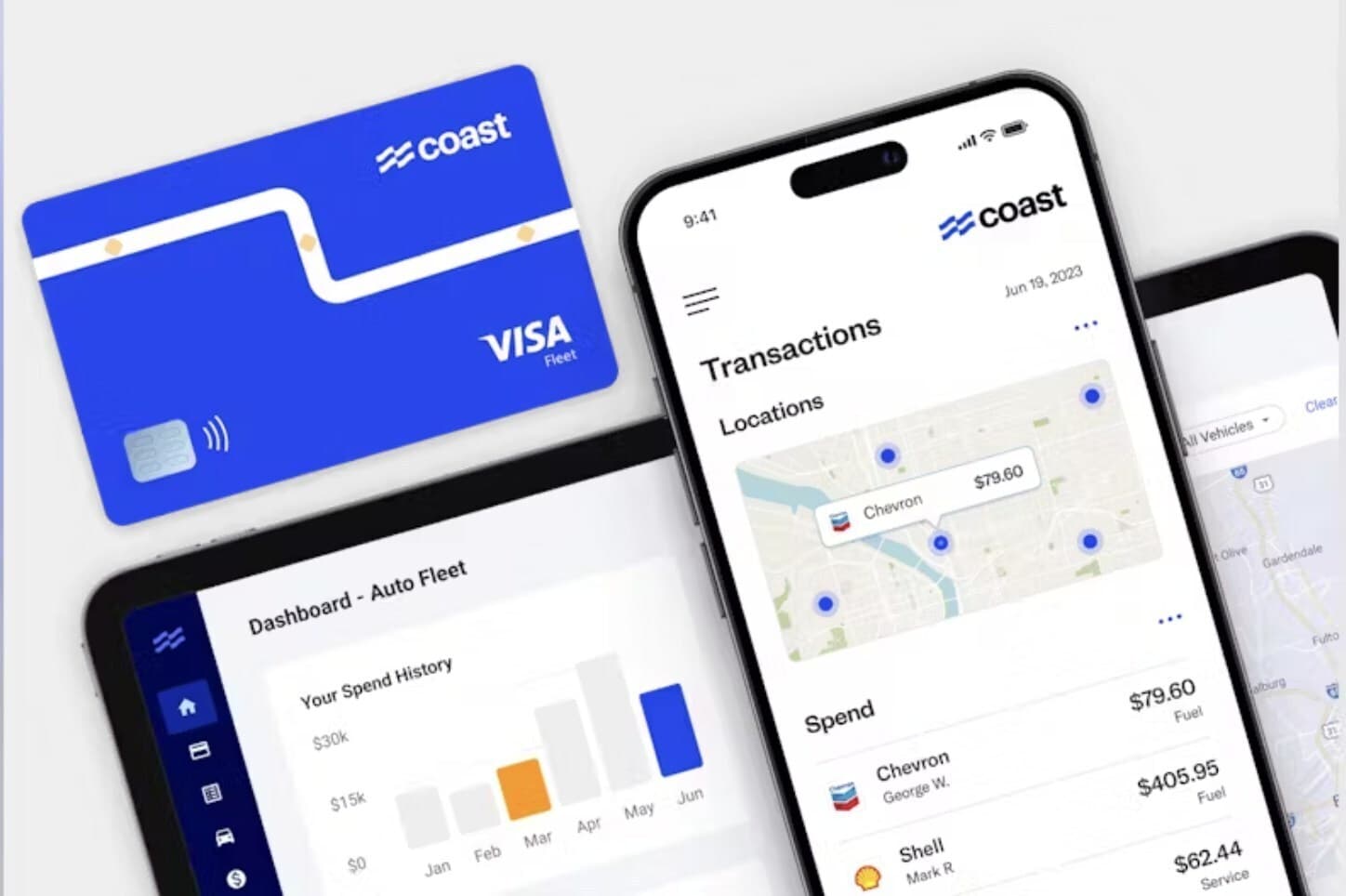
You can also use it for maintenance, parts, tolls, and material purchases. Transactions hit the dashboard instantly with full line-item detail, so you always know who fueled, where, when, and at what cost.
Coast offers 3¢–9¢ back per gallon at more than 30,000 participating stations, and 1% cash back on merchants other than gas stations.
Managers can set detailed rules by driver or vehicle, block certain merchant categories, add daily or weekly limits, and require receipts or job codes for larger transactions. This helps ensure the card is used appropriately. Every purchase appears in the dashboard with full line-item detail admins can check.
Coast’s fuel credit card also integrates with telematics systems. It automatically pulls mileage information from your telematics and matches it to your fuel transactions to help you track miles per gallon and identify unusual fuel use. For added fuel controls, Coast also leverages GPS location to check whether the company vehicle is at the station and fuel tank insights to ensure the amount of gas purchased matches what goes into the tank.
Coast also includes a $25,000 annual fuel-fraud guarantee covering both external and employee fraud (Terms apply).
- 3–9¢ back per gallon at 30,000+ stations
- Accepted anywhere that accepts Visa
- Detailed spend controls with real-time reporting
- Telematics and accounting integrations
- Mobile card unlock for added security
- Can also work as a controlled corporate card
- Includes a $25,000 annual Fuel Fraud Guarantee for added protection (learn more)
- Ability to turn on additional spend categories
- Designed for local service fleets rather than long-haul trucking
- Less suited for fleets with fewer than five vehicles
- No prepaid option
2. WEX
WEX is a fuel card company in the U.S., with acceptance at 95% of fuel stations and more than 45,000 maintenance locations.
Fleets can earn 1–3¢ per gallon at most participating locations with additional discounts available at WEX EDGE network stations. Larger fleets that buy more fuel each month typically qualify for higher rebates, while smaller operators may see lower savings unless they plan routes around in-network stations.
WEX offers controls for managing how and when drivers use their cards. Driver PINs connect each transaction to the right person, and you can set product limits, dollar caps, and time-of-day rules to help prevent off-policy spending.
- Accepted at 95% of gas stations
- Advanced spend controls
- Customizable report options
- Your local station might not accept the card
- Some cards have rebates that expire after a few months
- Rebates are broken into tiers and the amount you save is dependent on how much fuel you purchase in a given month
3. Comdata
Comdata offers a range of fleet fuel cards for trucking companies, from fuel cards for small businesses to larger ones with multi-vehicle fleets.
Small fleets primarily access diesel discounts at TA,Pilot and Love’s. Larger fleets have access to a broader set of tools to support driver funding and fleet spending at scale.
- Accepted at 95% of gas stations
- Advanced spend controls
- Customizable report options
- If you don't have a trucking business, you might not see the full value of the card
- Limited network of 8,000+ gas stations, when not using the Mastercard product
4. Fuelman
Fuelman offers a fleet fuel card used by small businesses, large businesses, and government fleets.
The Mixed Fleet and Diesel Fleet cards offer savings of 8¢ per gallon on unleaded or diesel, or 12¢ per gallon on diesel, at more than 40,000 stations in the Fuelman network. Fleets that want broader acceptance can choose the Fuelman Mastercard, which provides 3¢ per gallon on unleaded and diesel anywhere Mastercard is accepted.
Monthly fees can affect smaller fleets more noticeably, but Fuelman provides a combination of savings, controls, and reporting for fleets that fuel primarily within the network and maintain consistent payment practices.
- Real-time fraud alerts
- Discount network
- Fuel controls
- Some options like customizable dashboards, maintenance, or fraud guarantee are only available on more expensive plans
- Invoices must be paid in full and on time in order to receive rebates
- Your local station might not accept the card, and there’s an extended network fee of $3 for stations outside of their network
5. EFS
EFS offers several fleet fuel card options designed for different operational needs.
One of them, the EFS Fleet Card, is built for fleets that want strict spending controls.
The EFS Fleet Mastercard extends those same controls to any location that accepts Mastercard. For mixed-fuel fleets, the CrossRoads Freight Card provides access to fuel discounts at more than 12,000 truck stops across North America, along with acceptance at 95% of retail gas stations.
Smaller operations can use the Fleet One EDGE card, which has a simpler setup and includes discounts on fuel, tires, and repairs.
For fleets that fuel mostly in-network and want tighter oversight than a basic business credit card can provide, EFS offers a mature set of tools and controls.
- Valuable features for trucking businesses, such as cash advances and ATM withdrawal
- Mastercard product can be used for fuel and fleet expenses where Mastercard is accepted
- Spend controls
- Limited network of 12,000+ gas stations, if not using the Mastercard product
- Applies transaction fees to merchants out-of-network for EDGE card
- Might not be as valuable for non-trucking businesses
6. Voyager
The Voyager Fleet Card, issued by U.S. Bank, has a broad card acceptance. It works at more than 320,000 fueling locations, over 60,000 maintenance and repair shops, and more than 10,000 independent truck stops.
Managers can set controls by product type, dollar amount, time of day, and number of transactions. Drivers typically enter a PIN and, in many programs, an odometer reading before fueling, helping confirm both the driver and vehicle.
- Option between a Mastercard to maximize acceptance and a Voyager-only card for fleets needing access to private fueling sites and truck stops
- Spend controls and reporting
- Mastercard product is also accepted in Canada and Mexico
- If you choose the Voyager+ card, network of stations might be limited
- Mastercard product doesn't advertise any rebates
7. Shell
Shell offers fleet gas cards with rewards that support fuel management, charging, and basic on-the-road expenses. With 12,000+ Shell stations nationwide, drivers can refuel without major detours, and managers can track activity through Shell Fleet Hub. Controls can be set by day, time, product type, or station, with alerts for unusual activity.
→ Fuel Rewards Mastercard: Works at Shell and anywhere Mastercard is accepted
→ Fuel Rewards Credit Card: A Shell-only option best suited for fleets that fuel primarily at Shell
Both cards connect to the Fuel Rewards program, which benefits fleets that visit Shell stations regularly.
- Attractive rebates at Shell stations
- Option to choose between a Shell only card, and a card with 95% coverage
- Supports EV charging
- Rebates based on the number of gallons purchased. Small fleets might have trouble getting the full value.
- Shell Card Business can only be used at Shell stations
8. Chevron
The Chevron/Texaco Business Card program, issued by WEX, offers three options for fleets that want clearer control over fuel spending.
→ Business Card (Chevron/Texaco only): No setup, annual, or card fees. Works only at Chevron and Texaco stations, making it a practical fit for fleets that already fuel in-network.
→ Business Access + Business Access Flex: WEX states these cards are accepted at up to 95% of U.S. fuel stations and 45,000+ service locations through the WEX network. Tiered rebates of up to 6¢ per gallon apply at Chevron and Texaco, based on monthly fuel volume.
All three cards include detailed spend controls. Managers can set limits by product type, daily amount, time of day, or number of transactions. Drivers typically enter an ID and, in many cases, an odometer reading at each purchase, which supports security and accurate tracking. Transactions are captured automatically, so fleets don’t need paper receipts.
WEX’s Fleet SmartHub portal and mobile app provide real-time card activity, invoice payments, detailed reporting, and IFTA-ready data.
- Rebates at Chevron and Texaco stations
- Flexibility to choose between a Chevon/Texaco only card, and a card with 95% coverage
- Spend controls and reporting
- Rebates based on the number of gallons purchased. Small fleets might have trouble getting the full value.
- Chevron Business Card can only be used at Chevron and Texaco stations.
- Business Access Card charges $2/transaction fee when used outside of Chevron and Texaco stations

9. ExxonMobil
ExxonMobil offers two fleet cards that help businesses manage fuel spending and earn rebates at Exxon and Mobil stations.
→ FleetPro Card: Designed for mixed fleets and heavy-duty diesel vehicles. Works at 12,000+ Exxon and Mobil stations and 800+ commercial diesel pumps, with customized pricing and discounts.
→ BusinessPro Card: Available as private label or universal and powered by WEX. A fit for light-duty fleets (cars and vans). Accepted at 95% of U.S. fuel stations, including all Exxon and Mobil sites, with tiered rebates.
Managers get access to online and mobile tools to track transactions, download invoices and reports, and update cardholder settings. Controls can be set by product type, dollar limit, time of day, or merchant.
Drivers typically enter a PIN or odometer reading before fueling, and managers can receive alerts when activity looks unusual.
- Attractive rebates at Exxon and Mobil stations
- Spend controls and reporting
- Exxon only card has no setup, card or annual fees
- Unless you select their universal program, the card only be used at Exxon and Mobil stations
- If you want to get acceptance outside Exxon stations, you will need to upgrade to their Universal card, which has card fees
- Reliance on driver PINs leaves cards susceptible to fraud

10. Sunoco
Sunoco offers two fleet-fuel card options aimed at giving businesses either maximum savings or broad fueling flexibility:
→ Sunoco Business Fleet Card: Accepted at 5,000+ Sunoco locations and carries no setup, card, or annual fees. Fleets earn rebates on every gallon at Sunoco.
→ Sunoco Fleet Universal Card: Designed for fleets that need flexibility. It’s accepted at about 95% of U.S. gas stations and 45,000+ service locations, while still offering savings when fueling at Sunoco stations.
Both cards help fleet managers get control and visibility over fleet expenses. You can set spending limits by driver or vehicle, control purchases by fuel grade, location, time or amount, and require driver PINs and odometer readings at the pump for added security.
Transactions, reporting and invoicing are handled online or via mobile app.
- Up to 6¢ per gallon at Sunoco stations
- Spend controls and reporting
- No setup, card or annual fees
- Rebates are tier-based. If you do not purchase the right amount of gallons, you won't receive the full benefits.
- Reliance on driver PINs leaves cards susceptible to fraud
- Need to upgrade to Universal Card in order to get broader card acceptance, which involves a lot more fees via Wex
11. Pacific Pride
Pacific Pride is a cardlock-based fuel program designed for commercial fleets that want firm control over fuel spending.
Cards work at a large national network of commercial fueling sites, including Pacific Pride locations and partner stations across the country.
Each card can be tied to a specific driver or vehicle, with required PINs and optional odometer prompts. Managers can set limits by product type, gallon amount, dollar amount, time of day, or day of week. Because cards are restricted to fuel and related products, the risk of off-policy purchases is lower than with general-purpose payment cards.
Transactions are captured with pump-level detail and consolidated into a single invoice. Reporting tools make it easy to review usage by driver or vehicle and export data for accounting or fleet-management systems.
Many stations operate as commercial cardlock sites, offering 24/7 access and layouts suited to trucks, vans, and mixed fleets.
- Access to Pacific Pride cardlock network
- Spend controls and reporting
- Can use card to also purchase other vehicle-related items like motor oil, DEF, air/water/window cleaning equipment
- Can only be used at 55,000 sites
- Reliance on driver PINs leaves cards susceptible to fraud

12. Circle K
Circle K offers two fleet card options designed for businesses that want simple savings and clear oversight of fuel spending. The cards are accepted at more than 6,000 Circle K locations, where fleets receive automatic savings.
→ Pro Fleet Card: No monthly or annual fees. Works only at Circle K locations and covers fuel and car washes. It’s a straightforward choice for fleets that stay within the Circle K network.
→ Pro Universal Card: Accepted at 95% of U.S. fuel stations through the WEX network. Offers the strongest savings at Circle K and supports fuel, car washes, maintenance, repairs, and other WEX-accepted services. It does carry a monthly fee but provides wider coverage for fleets with varied routes.
Both cards use WEX’s security platform, requiring a driver ID and odometer reading at each transaction to help prevent misuse and maintain accurate records. Managers can set spending controls and track purchases through an online portal instead of collecting paper receipts.
- Zero card fees for Circle K Pro Fleet Card
- Save at least 10¢ on every gallon at Circle K stations
- Spend controls by transaction, vehicle, and driver
- Circle K Pro Fleet Card can only be used at Circle K stations
- Need to upgrade to Circle K Universal Card in order to get broader card acceptance
- Rebates are only available at Circle K stations
Choose The Right Fuel Cards For Your Business

Fleet fuel cards can be a valuable tool for businesses of all sizes. The Coast fleet and fuel card, for example, can help you save money on fuel, track your spending, and manage your fleet more efficiently.
Curious what the Coast fuel card could save you? Use our calculator below to see how tiny per-gallon savings turn into big wins.
With Coast’s online dashboard, you can manage expenses, see purchase details right down to the line item, and control every aspect of the card’s activity.
So, whether you operate five vehicles or 500 — and whether those vehicles stay in town or travel across the country — Coast can help you manage everything better.
To learn more about Coast, visit CoastPay.com today.
Fleet Fuel Card FAQs
What is a fleet fuel card?
A fleet fuel card is a payment card designed specifically for commercial vehicles and drivers.
Unlike a regular business credit card, a fleet card comes with built-in tools for managing fuel and vehicle-related spending.
Drivers use it to pay for fuel, maintenance, tolls, and other approved expenses while they’re on the road, and every transaction flows into one dashboard so managers can control limits, track usage, and spot unusual activity.
Fleet fuel cards are widely used because they make fueling simpler for drivers and give businesses far more visibility and control than a standard payment card ever could.
What are the best fleet fuel cards for small businesses?
The best fuel cards for small businesses are the ones that offer broad acceptance, simple controls, and clear pricing without locking you into a specific fuel brand.
Coast is a strong option because it’s accepted anywhere Visa is accepted, offers per-gallon rewards, and gives small fleets the same real-time controls and fraud protection larger fleets rely on.
Other widely used options include WEX, Fuelman, and Comdata, though many of these work best when your fleet fuels at specific in-network stations.
Are there any fleet fuel cards with no fees?
Yes. Several fleet fuel cards come with no setup, annual, or per-card fees, although most of them are tied to a specific fuel network.
In this list, the Chevron/Texaco Business Card, Circle K Pro Fleet Card, and Sunoco Business Fleet Card all advertise no setup, annual, or card fees as long as you fuel within their network.
The Axle Fuel Card also has no transaction, account-management, or monthly fees but is limited to Pilot, Flying J, and One9 locations.
These no-fee options can work well for businesses that fuel consistently at one brand’s stations. But for fleets that need nationwide acceptance or broader controls typically choose a universal card with transparent pricing instead.
Where can you use fleet cards?
Where you can use a fleet fuel card depends on the type of card you choose.
- Universal or open-loop cards (such as Visa- or Mastercard-backed fleet cards) can be used at virtually any gas station, truck stop, or merchant that accepts those networks. These offer the widest flexibility for drivers on varied routes.
- Branded or closed-loop cards only work at specific fuel brands or within a limited network. They often have no fees or higher rebates but require drivers to stay in-network.
Coast can be used anywhere Visa is accepted in the US and isn’t limited to fuel only purchases (unless your company wants it that way!). The spend controls can include maintenance and other vehicle related costs.
How do fleet fuel cards work?
Fleet fuel cards work by giving drivers a dedicated way to pay for fuel and approved vehicle expenses while automatically tracking every transaction. Each driver is assigned a card, or each vehicle is, and every purchase is logged with details like time, location, amount, and product type.
Managers use an online dashboard to:
- set spending limits
- block or allow certain merchants
- monitor transactions in real time
- spot unusual activity or possible fraud
Most fleet cards also require a driver ID or PIN at the pump, which ties each transaction to the right person. Some even have telematics integrations so that the card can only be used within a certain proximity of the vehicle it is assigned to. This makes it much easier to control costs and reduces the admin burden of collecting receipts or processing reimbursements.